Flute, Practicing

Practice Makes Progess

Perfectionism vs. Progress

Perfectionism is a terrible disease. I suffer from it as I know many others do. Especially as a flute player or musician or artist, perfectionism can be helpful or it can be detrimental. Yes, we should always strive to have all the correct notes, correct rhythms, correct dynamics, breaths, style, interpretation, vibrato, tone colors, phrasing, etc.

Can you see why perfectionism is an ongoing struggle?

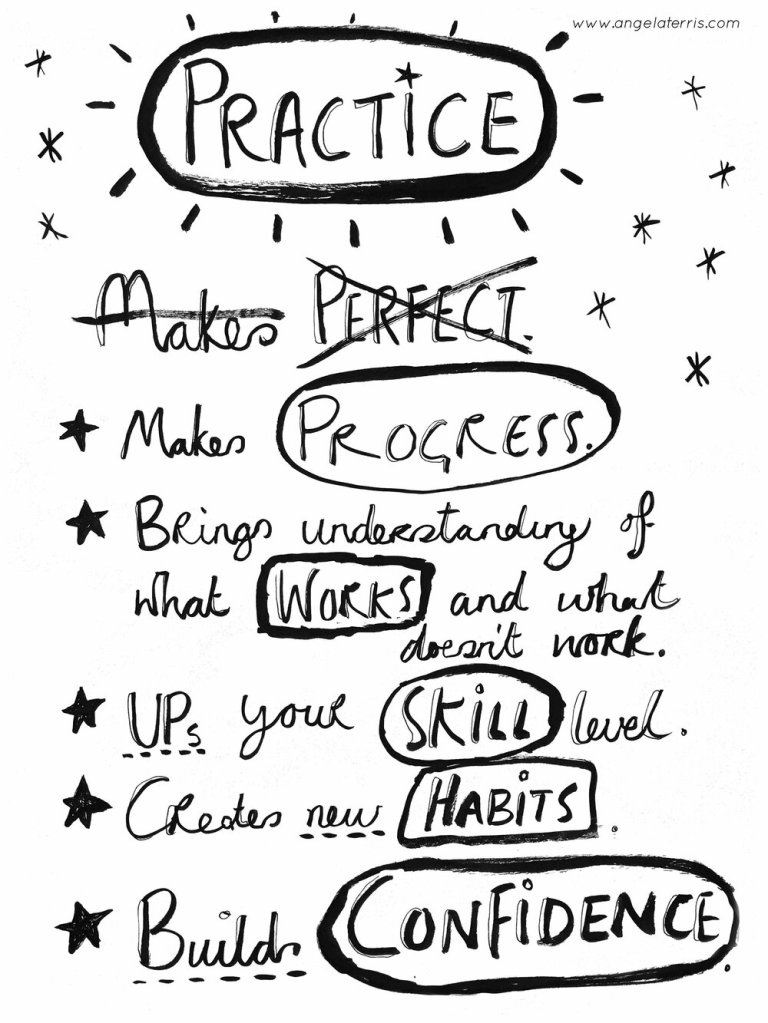
In music and in sports, you often hear the phrase Practice makes Perfect. I prefer to use the phrase Practice makes Progress. Here I thought I was so brilliant in coming up with this, but when searching for a photo to use, I found that I wasn’t as brilliant as I thought I was – haha.

The picture above says it all. If you don’t practice, you can’t expect progress.

Practicing is a developmental process to learn what methods are helpful to you. As a teacher I can attest that every student is different. What works for some doesn’t always work for others. That’s one of the things that makes teaching so fun. Finding and creating new ways to affectively teach each music student.

If you want to become a better flute player – or better at anything for that matter – you have to spend time working on that skill.

The more you practice, the better your flute playing habits will be whether those are good habits or bad habits. Hence the need for a private flute teacher to ensure you are practicing good habits.

The more you practice, the more confidence you can achieve with your tone, scales, songs and flute playing. It’s fun to really know a piece well and be confident with it, especially when preparing for a performance. That is impossible to achieve unless you are practicing smart. (That will be another post for another day.)

The main point is this: If you expect to improve as a flute player or anything else in life, you should practice consistently and regularly. That’s all there is to it.

“Practice makes Perfect Progress”.
Practicing

Michel Debost’s Scale Game

I took lessons from Michel Debost for 6 incredible months. I was introduced to his scale game several years before studying with him privately in Oberlin, Ohio. This quickly became my favorite way to practice the Taffanel-Gaubert Daily Exercise No. 4 every day. I would practice the first 30 on a daily basis, then on random days I’d play #31-60. Find what works best for you. This is from the book called 17 Daily Exercises for Flute which is a section taken from the Complete Method for Flute, both published by Alphonse Leduc.

Click on the following links for a PDF of what he is explaining. Enjoy!!

Rotation chart and page 1 and page 2 of notated music examples

This article by Frances Lapp Averitt is a reprint from the March 1988 issue of the Flute Talk magazine.

The Gamme [Scale]-Game of Michel Debost

The scale format devised by Debost consists of playing twice through all keys of the Taffanel-Gau­bert Daily Exercises, No. 4 using 60 articulations and rhythms. Though time-consuming, Debost’s scale exercises have great value. With diligent practice the flutist will achieve not only agility, but improve ar­ticulation, dynamics, and more important, tone. Each day the scale practice is different because of the key-rotation through the chart. I nicknamed this intriguing format The Gamme-Game. Following is a paraphrase of Debost’s scale instructions to his stu­dents.

Scales are the essential part of daily prac­tice and must be played by memory. Begin each day with a different key. Carefully define the transitions between scales by slurring them. Debost says that this transition is very im­portant to the musical feeling. “This is the time to rest, relax, and relieve tension by listening to and loving your tone. Taste every note like you are tasting wine.”

Always play the scales rhythmically. The pri­mary concern should not only be speed, but also cleanness and evenness of execution. Breathe after the first note of a group of eight. To breathe in scales with repeated notes, leave out notes when necessary so that the ongoing rhythm remains unaffected.

The scales of C major, C minor, D flat major, D# minor, D major and D minor are to be repeated one octave higher. Repeat the upper octave key right after the lower octave.
The chart gives 60 articulations and rhythms. Assign one scale at minimum to each example and persist with those that are most difficult to handle. These 60 combinations represent two complete play-throughs of the scales. The 12 ma­jor keys and 12 minor keys with 6 repetitions one octave higher give 30 patterns, multiplied by 2 to make a total of 60 different scales. This is the minimum to be practiced each day; the rou­tine takes about 45 minutes.

Nothing less than perfection is acceptable for scales: strive for evenness in all registers and tempos, attacks without cracking the tone, and control at all dynamic levels.

Key Rotation

  • Day One: K1 [meaning the Key-Chain] on C1 [meaning the Chart]; K2 on C2; K3 on C3, etc.
  • Day Two: (move forward one key): K2 on C1; K3 on C2; K4 on C3, etc
  • Day Three: (more forward another key): K3 on C1; K4 on C2; K5 on C3, etc.
  • Each day thereafter: move forward one more key for C1.

Suggestion: to keep track of your place in the key-chain, clip a paper clip over the key that will begin the next day.

Carefully define the transitions between the scales by always slurring them with a singing tone at a moderate or slow tempo. Assign only one scale to each example. Strive for evenness of tone and dynamic control.

-Michel Debost