Blog

Flute, Practicing

Practice Makes Progess

Perfectionism vs. Progress

Perfectionism is a terrible disease. I suffer from it as I know many others do. Especially as a flute player or musician or artist, perfectionism can be helpful or it can be detrimental. Yes, we should always strive to have all the correct notes, correct rhythms, correct dynamics, breaths, style, interpretation, vibrato, tone colors, phrasing, etc.

Can you see why perfectionism is an ongoing struggle?

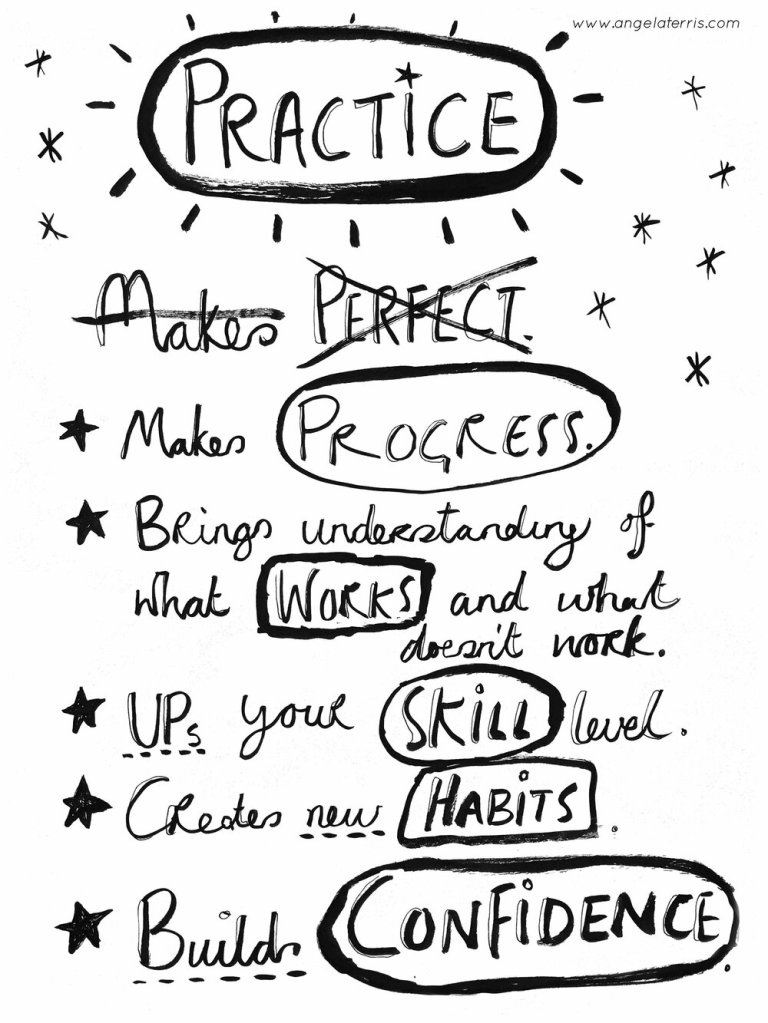
In music and in sports, you often hear the phrase Practice makes Perfect. I prefer to use the phrase Practice makes Progress. Here I thought I was so brilliant in coming up with this, but when searching for a photo to use, I found that I wasn’t as brilliant as I thought I was – haha.

The picture above says it all. If you don’t practice, you can’t expect progress.

Practicing is a developmental process to learn what methods are helpful to you. As a teacher I can attest that every student is different. What works for some doesn’t always work for others. That’s one of the things that makes teaching so fun. Finding and creating new ways to affectively teach each music student.

If you want to become a better flute player – or better at anything for that matter – you have to spend time working on that skill.

The more you practice, the better your flute playing habits will be whether those are good habits or bad habits. Hence the need for a private flute teacher to ensure you are practicing good habits.

The more you practice, the more confidence you can achieve with your tone, scales, songs and flute playing. It’s fun to really know a piece well and be confident with it, especially when preparing for a performance. That is impossible to achieve unless you are practicing smart. (That will be another post for another day.)

The main point is this: If you expect to improve as a flute player or anything else in life, you should practice consistently and regularly. That’s all there is to it.

“Practice makes Perfect Progress”.

Flute

Professional Flute Cleaning

I shared how to clean your flute in a blogpost dated April 5, 2023. How often should you have your flute cleaned professionally?

Many recommend taking your flute in once a year for a COA, which stands for Clean-Oil-Adjust. Basically, it’s just what it sounds like.

Clean: Your flute is disassembled and the headjoint, body, footjoint, and keys will be cleaned thoroughly.

Oil: The rods, screws and hinge tubes will be cleaned and have new oil put on them.

Adjust: The headjoint cork can dry out and shrink over time so it will be replaced. They change or shim pads, check and replace felts or other bumpers, if needed. Your flute is reassembled and the key motion is checked to ensure that everything is working properly. Finally, it gets a playing test and then any final adjustments to pads or screws will be made.

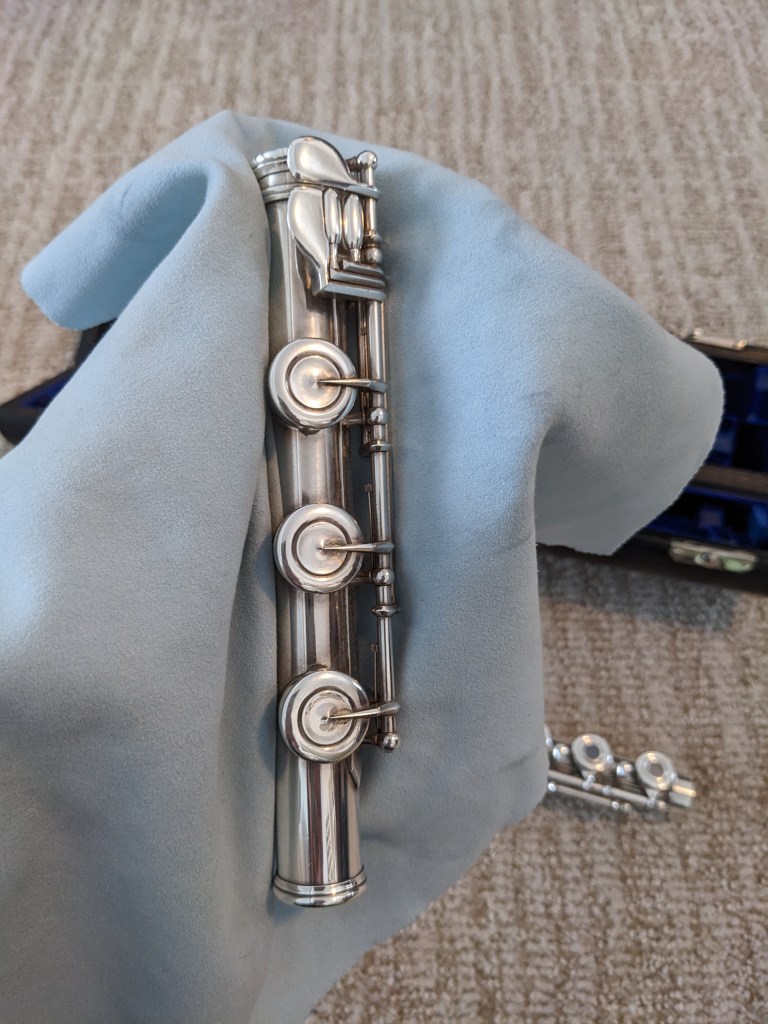
If you want to know more, you can find YouTube videos that show you how this is done. Do NOT try this at home! Leave it to a professional flute repairman. Please remember to NEVER use a silver polishing cloth.

If you have an old flute from “aunt so-and-so” or “grandma’s old flute” and it’s been sitting in a closet for a while, it will definitely need to be looked at by a professional technician to make sure it is in good working condition before starting flute lessons or band.

After your instrument has had a tune up, the most important thing is to take good care of your flute on a regular, daily basis. A properly working flute is a happy flute which makes for a happier flute player.

Practicing

Summer Flute Fun

Photo by Raphaël Biscaldi on Unsplash

Doesn’t this photo feel so carefree and fun? Summer is my favorite time of year, no matter how hot it gets. To me, summer is associated with less stress, vacations and fun times.

After all their hard work with festivals recently, I wanted to provide something fun for my flute students to practice over the summer. I compiled some summer fun flute songs including simple tunes such as Hot Cross Buns and Old MacDonald to My Country ‘Tis of Thee and a bunch in between.

I’m challenging my beginning to intermediate students to learn, transpose, and memorize as many as they can during the summer semester. Learning to transpose is a good ear training exercise. It helps you learn what intervals sound like and after hearing them in your head, learning what you need to do on the flute to make those intervals work. For example, are the notes stepping up or down a scale or are they skipping like an arpeggio? This skill can improve your memorization skills.

I had a student who was working on memorizing a song last year. After I pointed out to her that one section was just an arpeggio, she was able to play it from memory much easier.

Memorizing short little tunes can also help your brain understand the process which you can later apply to harder songs. Like many things in life, the more you do something, the easier it becomes. Print off the music and challenge yourself to have some flute fun by learning, transposing, and memorizing as many as you can.

Sending happy summertime wishes to you and have some fun!

Festivals, Flute

Congratulations May 2023

Congratulations to my graduating senior flute student this year who was accepted into the Brigham Young University music program! That is a tremendous accomplishment!!

Congratulations also goes out to two of my students for earning gold cups from the National Federation of Music Clubs. One student earned a 15 point gold cup in the flute solo event and the other student earned a 30 point gold cup for the combined flute/concerto event. That represents years of hard work and memorizing music. Way to go!

Performing

ATTITUDE

I love this quote by Charles Swindoll:

“The longer I live, the more I realize the impact of attitude on life. Attitude, to me, is more important than facts. It is more important than the past, than education, than money, than circumstances, than failures, than successes, than what other people think or say or do. It is more important than appearances, giftedness or skill. It will make or break a company…a church…a home. The remarkable thing is, we have a choice every day regarding the attitude we will embrace for that day. We cannot change the fact that people will act in a certain way. We cannot change the inevitable. The only thing we can do is play on the one string we have, and that is our attitude. I am convicinced that life is 10% what happens to me and 90% how I react to it. And so it is with you. WE ARE IN CHARGE OF OUR ATTITUDES.”